
Table of contents
- 1 What Is a Medical Spike?
- 2 Materials Used for Medical Spikes
- 3 International Standards for Medical Spikes
- 4 Key Functional Requirements for Closure-Piercing Devices
- 5 Vented vs Non-Vented Spikes
- 6 Types of Spike Connections
- 7 Specialised Spike Designs
- 8 Accessories Used with Medical Spikes
- 9 Understanding Drip Factor in Infusion Systems
- 10 Typical Applications of Medical Spikes
- 11 Designing Reliable Medical Fluid Management Systems
Medical Spikes for Infusion and Fluid Management Systems: Types, Standards and Applications
Medical spikes, also called closure-piercing devices or perforators, are essential components used in many single-use medical fluid management systems. They are designed to create secure access to the contents of fluid containers such as bags, bottles, vials, and rigid containers used for infusion, transfusion, irrigation, or enteral nutrition. Although often considered simple components, spikes play a critical role in ensuring reliable fluid transfer while maintaining compatibility with medical tubing systems and sterile packaging requirements. This article provides an overview of the main types of medical spikes, applicable standards, associated accessories, and common healthcare applications.
What Is a Medical Spike?
A medical spike is a plastic component used to pierce the closure of a medical fluid container and establish a fluid pathway between the container and the administration set. Spikes are commonly integrated into:
- Infusion sets
- Transfusion sets
- Enteral feeding systems
- Irrigation systems
- Fluid transfer devices
Their design must allow reliable penetration of the container closure while supporting safe and efficient fluid management.

Materials Used for Medical Spikes
Most medical spikes are manufactured from white ABS (Acrylonitrile Butadiene Styrene), which combines rigidity, dimensional stability, and cost-efficiency. Alternative material options may include:
Material selection depends on factors such as:
- Mechanical resistance
- Sterilisation compatibility
- Transparency requirements
- Assembly process compatibility
International Standards for Medical Spikes
Several international standards define the requirements applicable to spikes used in medical fluid administration systems. The most commonly referenced standards include:
- ISO 8536-4 – Infusion equipment for medical use – Infusion sets for single use, gravity feed
- ISO 1135-4 – Transfusion equipment for medical use – Transfusion sets for single use, gravity feed
These standards define:
- General chemical and biological requirements
- Physical and dimensional requirements
- Functional performance criteria for infusion and transfusion set components
Key Functional Requirements for Closure-Piercing Devices
According to these standards, medical spikes must meet several important requirements.
Dimensional Requirements
The geometry of the spike must comply with defined dimensions to ensure compatibility with medical containers and administration systems.
Penetration Capability
The spike must be capable of piercing and penetrating the container closure without requiring pre-perforation. This is particularly important in clinical environments where rapid and reliable connection is necessary.
Mechanical Resistance and Leak Tightness
For transfusion applications covered by ISO 1135-4, additional requirements apply. After insertion into a blood bag outlet compliant with ISO 3826-1, the spike must:
- withstand a 15 N tensile force for 15 seconds
- show no evidence of leakage
These requirements help ensure secure fluid transfer during use.
Vented vs Non-Vented Spikes
One of the main distinctions between medical spikes is whether they are vented or non-vented.
Non-Vented Spikes
A non-vented spike contains a single fluid pathway between the container and the administration line. These spikes are typically used with:
- Flexible bags
- Collapsible containers
As fluid exits the container, the flexible walls collapse naturally, eliminating the need for air intake.
Vented Spikes
A vented spike incorporates a second pathway connecting the container to the external environment. This air vent allows air to enter the container as fluid leaves it, helping maintain internal pressure equilibrium. Vented spikes are generally required for:
- Glass bottles
- Rigid plastic containers
- Non-collapsible réservoirs
Without air compensation, fluid flow could progressively slow down or stop. For flexible containers such as pouches, the vent is not necessary for fluid flow but helps ensure a steady flow rate. In fact, the flow rate could vary throughout the infusion or even stop if the bag is not flexible enough or if its walls stick together and block some of the fluid.
Types of Spike Connections
Medical spikes are available with several outlet configurations depending on the intended application.
Female Luer Connection
Some spikes are equipped with a female Luer connection, enabling compatibility with various medical tubing systems and connectors. 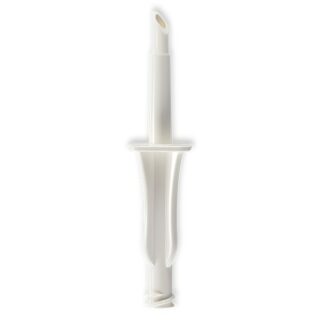
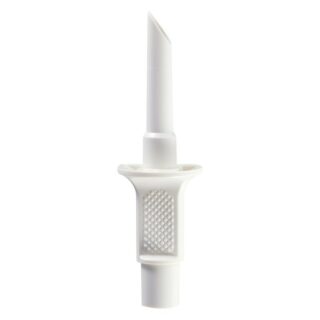
Tubing Connection
Direct tubing connection versions are also common. Typical dimensions include:
- 4.1 mm outer diameter
- 4.8 mm inner diameter
Other sizes are also available depending on tubing requirements.
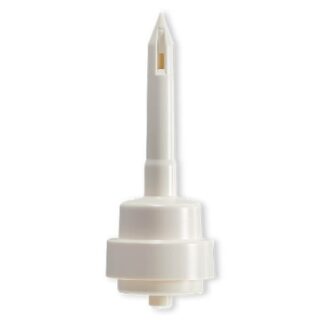
Drip Chamber Connection
Certain spikes are specifically designed for integration with a drip chamber. The connection dimensions may vary slightly between manufacturers, requiring compatibility verification during device design
Specialised Spike Designs
Several specialised spike variants exist for specific medical applications.
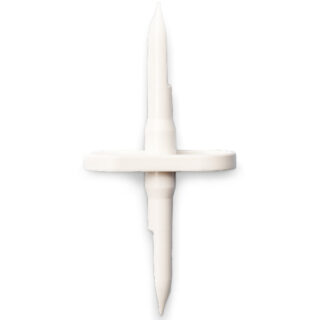
Transfer Spikes
Transfer spikes are double-ended devices designed to transfer fluids between:
- bags and bottles
- bottles and vials
- other medical fluid containers
They are commonly used in pharmacy preparation or fluid transfer applications.
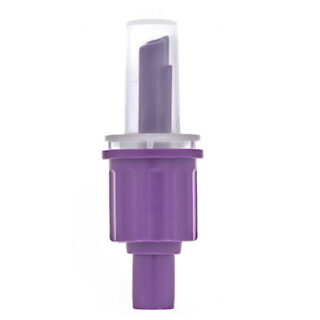
ENPlus and Cross Spikes
Enteral nutrition systems often use dedicated ENPlus-compatible spikes. These spikes feature a distinctive cross-shaped piercing section designed to connect specifically with ENPlus feeding containers. This design helps improve compatibility with enteral nutrition systems.
Vial Adaptors and Mini-Spikes
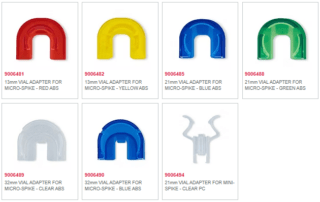
Vial adaptors combine a spike with a surrounding plastic fixation system that attaches securely to a vial closure. These devices are frequently used for:
- drug preparation
- fluid withdrawal from small containers
- pharmaceutical handling
Mini or micro spikes are often used in these applications. Their elongated fluid pathway helps maximize fluid recove ry when the vial is inverted.
Accessories Used with Medical Spikes
Several accessories can be associated with spikes to improve usability and system protection.
Protective Caps
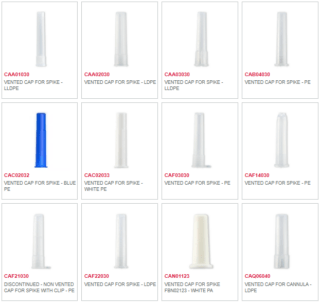
Protective caps are generally manufactured from polyethylene (PE). Their primary functions are:
- providing an aseptic protection before use
- preventing dust contamination
- protecting users during handling
These caps are not intended to provide leak-tight sealing.
Hydrophobic Filters
Hydrophobic filters can be integrated into the air vent of vented spikes. Their role is to help minimize:
- bacterial ingress
- particle contamination
- liquid leakage through the vent pathway
Typical materials include:
- PP or PE housings
- PTFE membranes
Different porosity levels and colour options are available.
Valve-Based Air Vents
Some vented spikes use valve systems instead of standard hydrophobic filters. These valves maintain hydrophobic and bacterial barrier functions while incorporating a defined cracking pressure. This means air enters the container only when a certain pressure difference is reached. Such systems may help protect the vent filter from accidental wetting caused by:
- excessive pressure
- accidental compression
- improper handling
When a filter becomes wet, its performance may be reduced. For many standard applications, however, a conventional hydrophobic filter remains sufficient.
Understanding Drip Factor in Infusion Systems
The spike itself does not directly control the flow rate. Instead, it influences the size of the drops formed inside the drip chamber, which affects flow monitoring precision. Flow adjustment is generally performed using a roller clamp.
Macrodrip Systems
Macrodrip systems typically deliver:
- 10 to 20 drops per mL
These are the most common configurations for standard infusion applications. Because the drops are larger, the relative error when counting drops is higher. However, this level of precision is generally acceptable for routine infusion therapy.
Microdrip Systems
Microdrip systems typically deliver:
- 60 drops per mL
Smaller drops allow more precise visual flow adjustment. These systems are particularly useful for:
- pediatric applications
- neonatal care
- low-flow infusions
At identical flow rates, the higher number of drops reduces relative counting error and improves precision.
Typical Applications of Medical Spikes
Medical spikes are used in a wide range of healthcare applications.
Infusion Therapy
Infusion sets commonly use spikes combined with drip chambers for fluid administration and hydration.
Blood Transfusion
Transfusion systems also integrate spikes and drip chambers specifically designed for blood component administration.

Oncology Applications
In oncology, spikes may use specific colours—such as opaque or transparent yellow versions—for product differentiation or identification purposes. The functional principle remains similar to standard gravity infusion systems.
Enteral Nutrition
Enteral feeding systems frequently use ENPlus-compatible spikes designed for nutrition containers.
Irrigation Systems
In irrigation applications such as:
- endoscopy
- dental procedures
- surgical irrigation
drip chambers are often unnecessary because flow regulation may instead be controlled using:
- manual pumps
- peristaltic pumps
- dedicated irrigation systems
Designing Reliable Medical Fluid Management Systems
Although small in size, medical spikes are essential components in many disposable medical devices and fluid administration systems. Their design influences:
- container compatibility
- flow management
- contamination control
- user handling
- system integration
Selecting the appropriate spike configuration depends on many factors, including the type of container, fluid pathway design, application requirements, and intended clinical use. Promepla’s team can support medical device manufacturers in selecting the most appropriate components for their fluid management applications. If you already know what you are looking for, you can also browse our component catalogue and request samples directly from our team.

Latest news

November 6, 2025
Customers IFU

Our websites