
Table of contents
- 1 What Is 2K Injection Moulding?
- 2 How Does the 2K Injection Moulding Process Work?
- 3 Why Use 2K Injection Moulding for Medical Components?
- 4 Typical Medical Applications of 2K Injection Moulding
- 5 Material Selection Considerations
- 6 Is 2K Injection Moulding Suitable for Single-Use Medical Devices?
- 7 Future Trends in Medical Injection Moulding
- 8 Conclusion
2K Injection Moulding for Medical Components: What Is It and Why Is It Used?
As medical devices become increasingly sophisticated, manufacturers are continuously looking for ways to improve component functionality, simplify assembly processes, and enhance manufacturing efficiency. One technology that is gaining significant attention in the medical industry is 2K injection moulding, also known as two-component injection moulding, multi-material moulding, or bi-material injection moulding. This manufacturing process allows two different thermoplastic materials—or two different colours of the same material—to be combined into a single component during a fully integrated moulding cycle. In addition, the 2K injection moulding process is a reliable method of integrating a sealing lip into a component. Fusing a rigid material with a flexible one creates a secure bond for the sealing surfaces. For manufacturers of single-use medical devices and medical components, 2K injection moulding offers new design possibilities while helping reduce the number of parts and assembly operations required.
What Is 2K Injection Moulding?
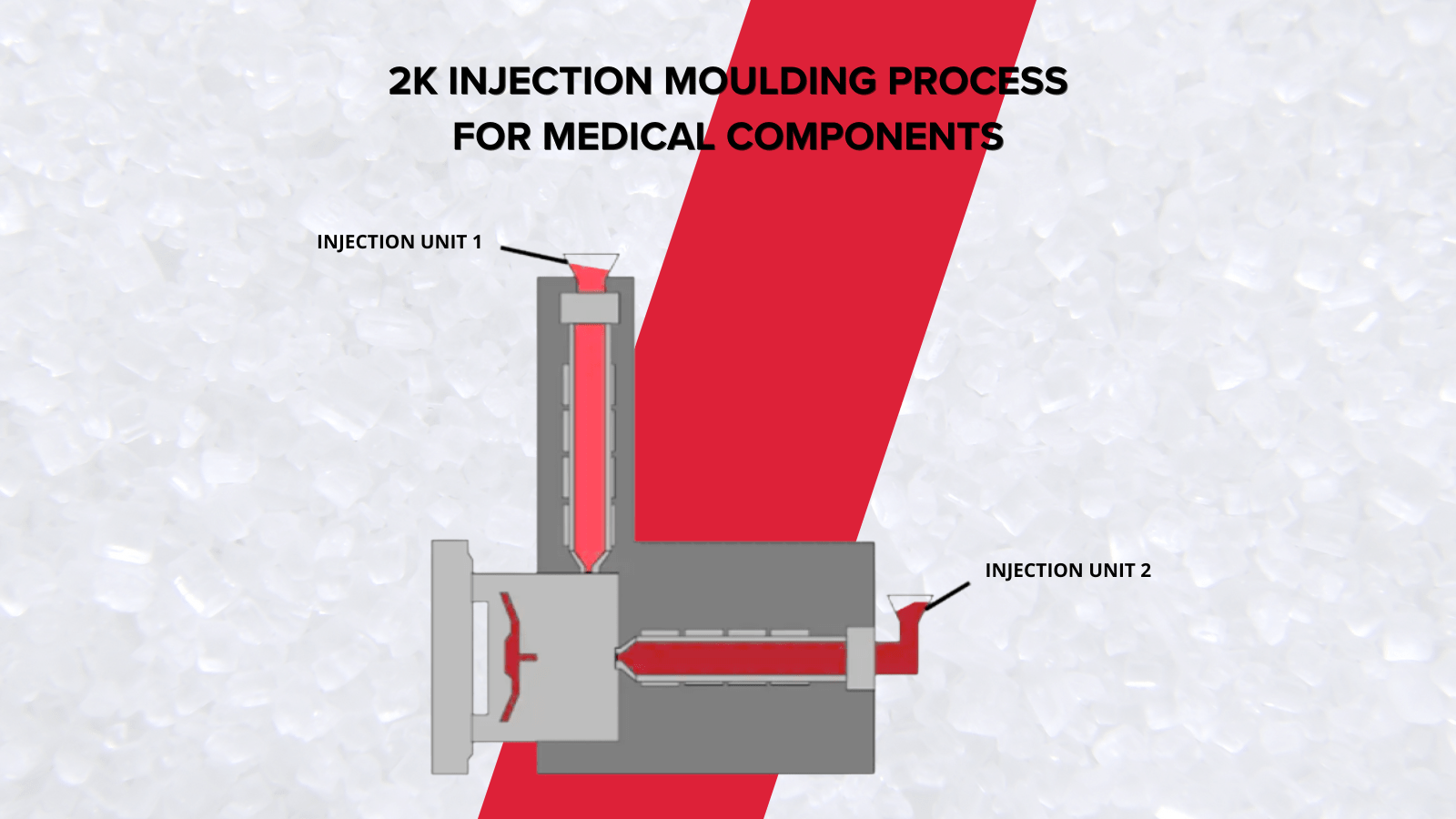
2K injection moulding is a manufacturing process in which two materials are injected sequentially into the same mould to create a single finished component. Unlike conventional injection moulding, where one material is moulded at a time, 2K moulding uses a specialised machine equipped with two injection units. The first material is injected into the mould to form the base structure of the component. The mould then rotates, slides, or indexes, allowing the second material to be injected directly onto or around the first material. The result is a single component combining the properties of two materials without requiring additional assembly operations. In the medical industry, common material combinations include:
- Polypropylene (PP) and thermoplastic elastomer (TPE)
- Polycarbonate (PC) and TPE
- Copolyester (CoPET) and TPE
- Polypropylene (PP) and polyethylene (PE)
- Two colours of the same polymer for identification purposes
The selection of compatible materials is a critical part of the design process, as the materials must bond effectively while meeting the intended functional requirements.
How Does the 2K Injection Moulding Process Work?
Although several technical variations exist, the general process follows four main steps:
1. First Material Injection
The first polymer is injected into the mould cavity to form the main structure of the component. This portion typically provides the mechanical strength and dimensional stability required for the application.
2. Transfer Within the Mould
Once the first shot has partially cooled, the mould transfers the component to a second position. This transfer can be achieved through rotating platens, indexing systems, or movable mould inserts.
3. Second Material Injection
The second material is then injected onto selected areas of the first component. This material may provide:
- Flexibility
- Sealing functions
- Soft-touch surfaces
- Colour coding
- Additional functional features
4. Component Ejection
After cooling, the fully integrated component is ejected from the mould as a single finished part. No secondary bonding, gluing, welding, or manual assembly is required.
Why Use 2K Injection Moulding for Medical Components?
The medical device industry places high demands on manufacturing consistency, cleanliness, and process control. In many cases, 2K injection moulding can offer advantages compared with traditional assembly methods.
Reduced Part Count
One of the most obvious benefits is the ability to combine multiple functions into a single component. Instead of producing separate rigid and flexible parts that must later be assembled, manufacturers can integrate these functions directly during moulding. Reducing the number of individual components may simplify supply chain management and production processes.
Elimination of Secondary Assembly Operations
Many medical components require soft sealing elements, membranes, or grips to be attached to a rigid plastic body. Traditionally, this may involve:
- Solvent bonding
- Adhesive bonding
- Ultrasonic welding
- Mechanical assembly
2K injection moulding eliminates the need for these additional manufacturing steps by creating the bond directly during moulding. This can contribute to a more streamlined production process and reduce handling of individual parts.
Consistent Material Positioning
When seals, membranes, or flexible features are moulded directly onto a rigid substrate, their positioning is defined by the mould geometry itself. This can improve repeatability and reduce variability associated with manual assembly processes.
Design Flexibility
Medical device designers increasingly seek to integrate multiple functions into compact components. 2K moulding can support innovative designs by combining materials with different properties, such as:
- Rigidity and flexibility
- Transparency and opacity
- Different colours
- Different friction characteristics
This flexibility enables engineers to optimise component functionality while maintaining compact designs.
Typical Medical Applications of 2K Injection Moulding
Two-component injection moulding is used across a wide range of medical and healthcare applications.
Components with Integrated Seals
One of the most common applications involves components that require both a rigid body and a flexible sealing element. Examples include:
- Closure caps
- Connectors
- Fluid management components
- Access ports
- Medical housings
In these applications, a soft TPE seal may be moulded directly onto a rigid polypropylene or polycarbonate body.
Membranes and Valve Components
Some medical devices require flexible membranes that interact with fluids or air pathways. 2K moulding allows these membrane features to be integrated directly into the component structure during production.
Colour-Coded Medical Components
Colour differentiation is widely used in healthcare environments to assist product identification and workflow management. Two-component moulding can incorporate multiple colours into a single component without additional printing or assembly operations. Examples may include:
- Fluid management systems
- Connectors
- Stopcocks
- Caps and closures
Ergonomic Components
Certain medical devices benefit from soft-touch surfaces that improve handling. By combining rigid and flexible materials, manufacturers can create components that are easier to grip while maintaining structural integrity.
Material Selection Considerations
Successful 2K injection moulding depends heavily on selecting compatible materials. Several factors must be considered:
Bonding Compatibility
Not all thermoplastics bond naturally to one another. Material combinations must be carefully evaluated to ensure adequate adhesion between the two moulded layers.
Mechanical Performance
The selected materials must provide the required mechanical properties for the intended application, including:
- Strength
- Flexibility
- Impact resistance
- Durability
Sterilisation Compatibility
Medical components may be exposed to sterilisation methods such as:
- Ethylene oxide (EtO)
- Gamma irradiation
- Electron beam sterilisation
Material selection should take these sterilisation processes into account during product development.
Regulatory Considerations
Materials used in medical devices must be evaluated within the context of the final device design, intended use, applicable regulations, and risk management activities. Manufacturers should ensure that material selection aligns with their overall quality and regulatory strategy.
Is 2K Injection Moulding Suitable for Single-Use Medical Devices?
Yes. Two-component injection moulding is increasingly used in the manufacture of single-use medical components and disposable medical devices. The process is particularly relevant when:
- High production volumes are required
- Integrated sealing functions are needed
- Assembly operations need to be reduced
- Consistent component quality is important
Because many disposable medical devices incorporate fluid management functions, connectors, caps, valves, or access ports, 2K moulding can provide an efficient manufacturing solution.
Future Trends in Medical Injection Moulding
As medical devices continue to evolve, manufacturers are increasingly looking for ways to integrate more functionality into fewer components. Advances in material science and moulding technology are expanding the range of compatible material combinations and enabling more complex designs. At the same time, growing demand for manufacturing efficiency, traceability, and process control is encouraging wider adoption of integrated production technologies such as 2K injection moulding. For medical device manufacturers seeking innovative component solutions, two-component moulding represents a valuable tool for combining functionality, efficiency, and design flexibility within a single manufacturing process.
Conclusion
2K injection moulding has become an important manufacturing technology for medical components that require the combination of different material properties within a single part. By enabling rigid and flexible materials, seals, membranes, or colour-coded features to be integrated directly during moulding, the process can reduce assembly requirements and support innovative component designs. As the medical industry continues to pursue greater efficiency and increasingly sophisticated devices, two-component injection moulding is likely to play an expanding role in the development and manufacture of future medical components. To support these evolving needs, A. Hopf has recently expanded its manufacturing capabilities with the addition of a two-component (2K) injection moulding machine. This technology enables us to manufacture medical components combining two materials or colours within a single, integrated moulding process. Our team can support medical device manufacturers in evaluating whether 2K injection moulding is appropriate for their application and in developing components that take advantage of this manufacturing technology.

Latest news
November 6, 2025
Customers IFU

Our websites